Contact Us

SinglePoint Vendor Payments: AP Automation, Virtual Cards & ERP Connectors

SinglePoint vendor payments turn Accounts Payable from a manual cheque run into a lights-out disbursement engine. ERP connectors for SAP, Oracle NetSuite, Microsoft Dynamics 365, Sage Intacct and QuickBooks feed invoices into SinglePoint; dual-control approval releases ACH, wire, virtual card or cheque payments as the vendor master prescribes.

Per the Consumer Financial Protection Bureau guidance on B2B payment integrity, supplier authentication and beneficiary-data controls are central to fraud prevention. SinglePoint implements both — vendor master approval workflow, banking-detail change verification and dual-control release on every payment.

Release an AP Batch Connect Your ERP
SinglePoint vendor payments dashboard showing ACH, wire, virtual card and cheque methods with ERP feed and 3-way matching

AP Automation, From Invoice to Remittance

Every vendor payment cycle follows the same arc — vendor master, invoice ingest, matching, approval, release and remittance. SinglePoint owns every step.

Vendor Master File

The vendor master in SinglePoint holds every approved supplier, the preferred payment method, banking details, remittance email, Tax ID and W-9 status. Banking-detail changes require dual-control approval before they take effect — the core control against business-email-compromise fraud attempts. Inactive vendors auto-flag after a configurable dormant-period threshold.

3-Way Matching

3-way matching reconciles purchase order, goods-received note and invoice before a payment releases. SinglePoint pulls all three from the connected ERP, compares PO line item, quantity and unit price, and flags variances beyond tolerance (typically 2-5% unit, exact quantity). Clean matches flow straight to approval; exceptions queue for AP review.

Virtual Cards for AP

Virtual commercial cards on the U.S. Bank Visa network issue a 16-digit account with configurable spending cap, expiration and vendor restrictions. SinglePoint sends the virtual card directly to the supplier; the supplier charges the card; U.S. Bank settles same-day via Visa. The originating client pays the commercial card statement on standard terms — often earning rebate on the spend.

Dynamic Discounting

Dynamic discounting lets treasury offer early payment against a negotiated discount per day-early. SinglePoint surfaces the annualized yield on each accelerated payment — treasury compares captured discount against cost of working capital. Suppliers opt in per invoice or per relationship; the SinglePoint approval record captures the agreed discount against the original net-30 terms.

Payment Methods and ERP Connectors

Four payment methods, seven ERP connectors, one SinglePoint approval queue.

Routing Reference

  • ACH CCD / CTX — default for domestic suppliers; low cost; Same-Day or Next-Day settlement.
  • Fedwire — high-value domestic vendors needing same-day settlement beyond the Same-Day ACH cap.
  • SWIFT MT103 — international suppliers across 180+ countries.
  • Virtual Visa card — single-use 16-digit account with spending cap and expiration.
  • Cheque print-and-mail — fallback for suppliers without electronic receive capability.
  • ERP connectors — SAP, Oracle NetSuite, Dynamics 365, Sage Intacct, QuickBooks, Workday and middleware.
Payment Method Cost Settlement Vendor Visibility
ACH CCD+ Lowest per-entry Same-Day or Next-Day Remittance in 80-char addenda
ACH CTX Low per-entry Same-Day or Next-Day Up to 9,999 EDI 820 addenda
Fedwire Domestic Higher per-entry Real-time same-day OBI free-form remittance field
SWIFT MT103 International Higher per-entry 1-2 business days Field 70 remittance information
Virtual Visa Card Rebate-earning for originator Same-day via Visa network Card number sent to supplier
Cheque Print-and-Mail Moderate per-entry 3-5 business days by mail Remittance stub on cheque

ERP Integration Patterns

Pre-built connectors for the ERP stack most American middle-market and enterprise clients run.

SAP, Oracle and Microsoft Dynamics

Enterprise clients connect SinglePoint to SAP S/4HANA and ECC, Oracle NetSuite, Oracle Fusion Cloud and Microsoft Dynamics 365 Finance. Connectors export paid invoices as NACHA or ISO 20022 format and import remittance acknowledgements back into the ERP GL. Vendor master updates flow bidirectionally so the same supplier record exists in both systems.

For SAP, the connector uses RFC or IDoc; NetSuite uses SuiteTalk SOAP or REST API; Dynamics 365 uses Dataverse APIs. SinglePoint publishes connector metadata for middleware platforms (Boomi, MuleSoft, Workato) where clients orchestrate their integration layer separately.
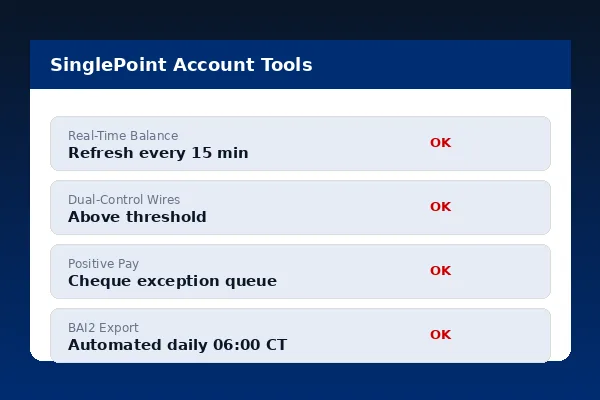
SinglePoint ERP connector architecture showing SAP, NetSuite, Dynamics 365 and Sage integration flows
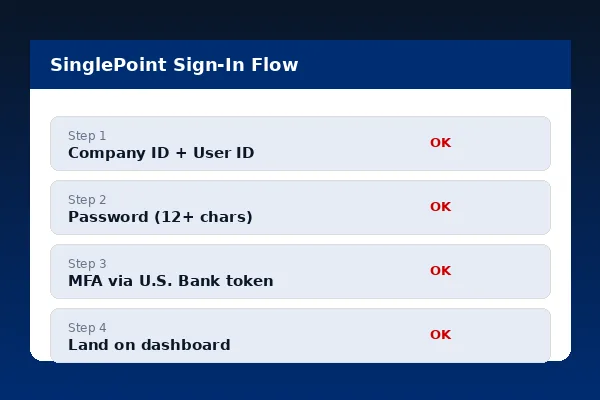
SinglePoint 3-way matching reconciling purchase order, goods-received note and supplier invoice

Sage Intacct, QuickBooks & SMB

Small and mid-market clients connect SinglePoint to Sage Intacct, Sage 300, QuickBooks Online and QuickBooks Desktop. These connectors carry lighter payloads — vendor master, invoice batch and payment confirmation — and run in hours to set up. QuickBooks Online connects via OAuth-protected API; QuickBooks Desktop connects via secure file drop.

For clients without a connected ERP, SinglePoint accepts CSV and NACHA batch uploads directly through the browser or FTPS. Batch upload is the fallback for spreadsheet-driven AP teams migrating toward automation.

Remittance Detail and Reconciliation

Vendors expect remittance detail with the payment. SinglePoint carries detail natively — CCD+ carries an 80-character addenda, CTX carries up to 9,999 EDI 820 addenda, Fedwire uses the OBI (Originator to Beneficiary Information) free-form field, SWIFT uses Field 70. For clients requiring separate remittance delivery, SinglePoint emails a branded remittance advice to the vendor email on file at release.

Reconciliation runs through SinglePoint transaction reporting with BAI2, MT940 and CSV export. AP closes every payment against PO and invoice number — no manual tie-out.

SinglePoint vendor remittance advice email and BAI2 reconciliation feed to ERP

SinglePoint Vendor Payments By the Numbers

Operational scope of SinglePoint AP automation for American commercial clients.

4Payment Methods per Vendor
8+ERP Connectors
9,999CTX Addenda per Entry
7 yrsAP Audit Retention

Explore Adjacent Services

Vendor payments combine with ACH, wires and reporting inside the same SinglePoint session.

ACH Payments

NACHA CCD+ and CTX origination for domestic supplier disbursement at lowest cost.

Wire Transfers

Fedwire and SWIFT for high-value or urgent vendor settlement beyond the ACH cap.

International Payments

Cross-border SWIFT, IAT and Directo a Mexico for global supplier networks.

Bill Payments

Scheduled biller payments for tax, utilities, telco and recurring commercial payables.

Payroll

PPD direct deposit for W-2 employees alongside CCD/CTX for 1099 suppliers.

Treasury Management

ZBA sweeps and positive pay on the AP funding account inside SinglePoint.

Transaction Reporting

BAI2, MT940 and CSV export so every vendor payment reconciles against the ERP GL.

Business Checking

The funding account that settles every ACH, wire, virtual card and cheque run.

People Also Ask About SinglePoint Vendor Payments

Which ERPs connect to SinglePoint vendor payments?
SinglePoint connects natively or via middleware to SAP S/4HANA, SAP ECC, Oracle NetSuite, Oracle Fusion Cloud, Microsoft Dynamics 365 Finance, Sage Intacct, Sage 300, QuickBooks Online and QuickBooks Desktop.
What payment methods does SinglePoint support for vendors?
ACH CCD+/CTX, Fedwire domestic wire, SWIFT MT103 international wire, virtual Visa commercial card and printed cheque. Each vendor's preferred method lives in the SinglePoint vendor master.
What is 3-way matching in SinglePoint?
3-way matching reconciles purchase order, goods-received note and invoice. SinglePoint matches by PO, line item, quantity and unit price; variances beyond tolerance route to the AP exceptions queue.
How do virtual cards work inside SinglePoint?
Virtual commercial cards are 16-digit Visa accounts with a spending cap and expiration. SinglePoint issues the card to the vendor; U.S. Bank settles same-day via Visa; the client pays on standard commercial card terms — often earning rebate.
What is dynamic discounting in SinglePoint?
Dynamic discounting accelerates payment in exchange for a per-day discount. SinglePoint surfaces the annualized yield so treasury compares captured discount against cost of working capital.

Activate SinglePoint Vendor Payment Automation

Whether you process 100 invoices per month or 100,000 per quarter, a U.S. Bank Commercial Banking advisor can scope SinglePoint AP entitlements, ERP connectors and virtual card programs for your business.

Contact a Relationship Manager

Commercial Banking Portal — Topic Cluster