Contact Us

SinglePoint Privacy Notice

This Privacy Notice explains how SinglePoint, a commercial banking portal operated by U.S. Bank National Association (a subsidiary of U.S. Bancorp), collects, uses, shares and retains non-public personal information and business customer information in alignment with the Gramm-Leach-Bliley Act (GLBA), the California Consumer Privacy Act as amended by the California Privacy Rights Act (CCPA/CPRA), the New York SHIELD Act, the Massachusetts 201 CMR 17.00 data security regulation and the Dodd-Frank Act privacy provisions. Last updated 2026-04-18.

SinglePoint is a commercial product and does not knowingly collect information from consumers under 18 or provide business banking services to children. For retail U.S. Bank personal online banking privacy, users should consult the U.S. Bank retail privacy notice distributed with their account agreement.
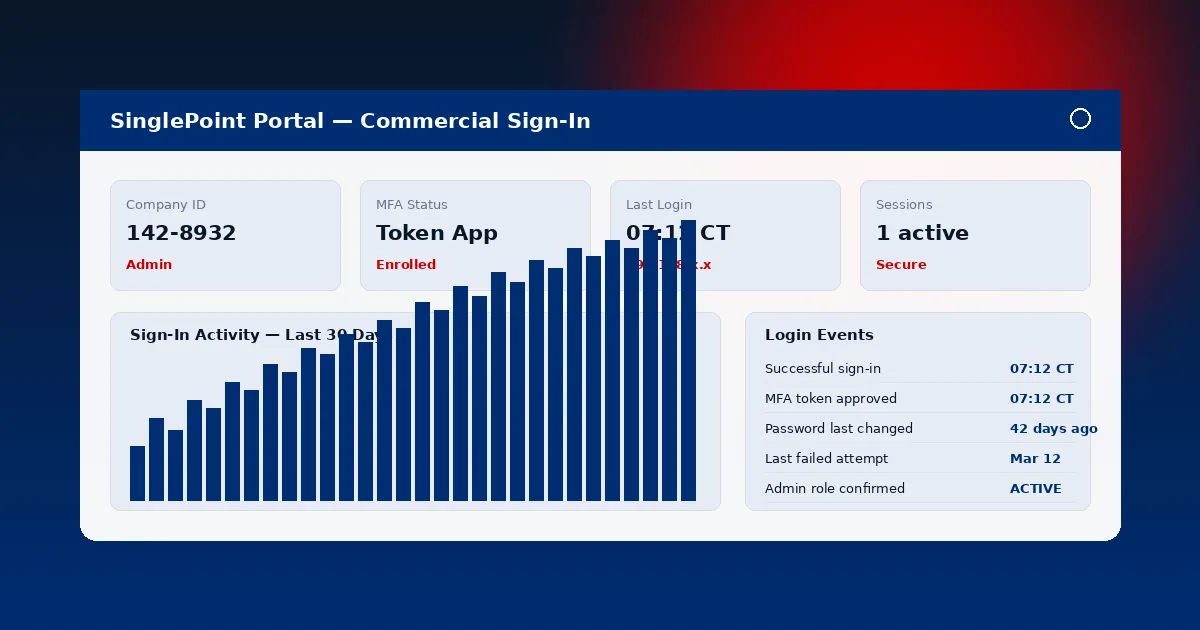
SinglePoint Privacy Notice cover showing GLBA, CCPA/CPRA and NY SHIELD alignment

Information We Collect

SinglePoint collects information necessary to provide commercial banking services, comply with federal and state law, and secure the portal.

Data Retention Snapshot

  • Identifiers — name, User ID, Company ID, email, phone, business address, Tax ID (EIN).
  • Financial Information — account numbers, balances, transactions, beneficiary details, wire and ACH history.
  • Technical Data — IP address, device fingerprint, browser type, session logs, timestamps.
  • Authentication — password hashes, token device bindings, biometric attestations (no biometric itself).
  • Behavioural — navigation patterns, feature usage, report access history (for fraud detection).

How We Use Your Information

Every SinglePoint use of personal and business data is anchored to a defined purpose.

Banking Services

Process wire transfers, ACH payments, bill payments, foreign exchange, treasury operations and reporting. Without this information, SinglePoint cannot execute the contracted commercial banking services. Customer Information Program (CIP) obligations under the USA PATRIOT Act require collection and retention of identifying information at account opening.

Fraud Prevention

Detect unusual patterns, anomalous sign-in attempts, suspected account takeover, elder financial abuse and commercial payment fraud. Behavioural analytics run on authenticated session data. Suspicious activity triggers Step-Up authentication, administrator alerts and in some cases hold-and-review on pending payments.

Regulatory Reporting

Bank Secrecy Act (BSA) and FinCEN reporting including Currency Transaction Reports (CTRs) over $10,000, Suspicious Activity Reports (SARs), Office of Foreign Assets Control (OFAC) sanctions screening, IRS 1099-INT/1099-MISC reporting, FDIC and OCC supervisory examinations. These are legally mandated and not subject to customer opt-out.

Communications

Operational notifications (security alerts, payment confirmations, statement availability, token expiry), service announcements (maintenance, feature launches) and elective marketing communications. Marketing is opt-out; operational and regulatory communications are not opt-out because they are required for the safe operation of the account.

Consent and Third-Party Disclosure

SinglePoint discloses non-public personal information only in the categories and to the parties described below.

Data CategoryPurposeRetentionShared With
Identifiers (name, EIN, address)Account opening, CIP, KYC7 years post-closureRegulators, service providers, affiliates
Transaction recordsBanking services, reporting7 years (OCC, IRS)Federal Reserve, clearing networks, regulators
Authentication (hashes, tokens)Access control, fraud preventionDuration of relationship + 2 yearsInternal only
Technical (IP, device fingerprint)Security, fraud detection2 yearsFraud vendors under GLBA safeguards
Behavioural (usage patterns)Fraud, product improvement2 yearsInternal only
Communications (emails, calls)Service, dispute resolution5 yearsInternal; regulators on lawful request
Cookies (session, preference)Authentication, UXSession to 24 monthsInternal only

Third Parties with Whom We Share

Regulators and Law Enforcement

FDIC, OCC, Federal Reserve, CFPB, FinCEN, IRS, state banking regulators, OFAC, the Consumer Financial Protection Bureau and state Attorneys General when lawfully requested, under subpoena, or to comply with BSA/AML obligations. SinglePoint challenges overbroad requests and notifies customers where permitted by law.

Service Providers

Cloud infrastructure, data centres, fraud detection vendors, email delivery, telecom, audit firms, legal counsel. All service providers operate under written contracts requiring GLBA Safeguards Rule compliance, data processing addenda, and back-to-back SOC 2 attestations where they handle SinglePoint data at scale.

Affiliates Within U.S. Bancorp

U.S. Bank affiliates within the U.S. Bancorp group may receive information to provide related financial services (treasury, wealth, capital markets) where the customer relationship extends. Under GLBA, sharing with affiliates for everyday business purposes is permitted without opt-out; sharing for marketing purposes is opt-out enabled.

No Sale of Personal Information

SinglePoint does not sell personal information for monetary or other valuable consideration as defined by CCPA/CPRA. SinglePoint does not share personal information for cross-context behavioural advertising. The Global Privacy Control signal is honoured where technically supported.

Cross-Border Data Transfers

SinglePoint stores and processes data in United States data centres. Primary production data centres are located in Minneapolis, Minnesota and disaster recovery sites in the south-eastern United States. SinglePoint does not transfer customer data outside the United States for day-to-day operations.

Where service providers operate globally (for example, email delivery or analytics), contractual controls limit the categories and geographies of data transferred. SinglePoint contractually prohibits service provider access from jurisdictions sanctioned by OFAC.

Security and Retention

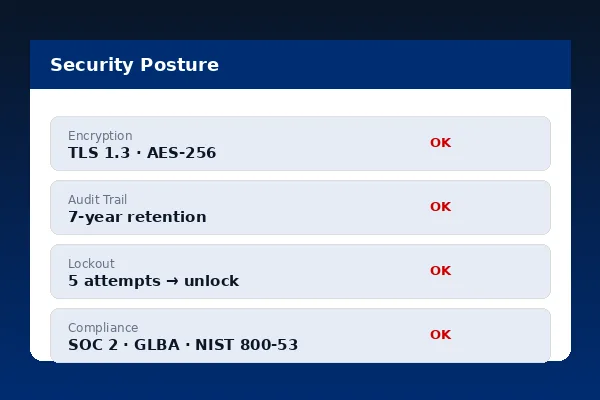
SinglePoint aligns to NIST 800-53, SOC 2 Type II and OCC record-keeping expectations.

NIST 800-53Control Framework
SOC 2Type II Attested
AES-256Data at Rest Encryption
TLS 1.3Transport Encryption

Security Safeguards

SinglePoint implements administrative, technical and physical safeguards as required by GLBA Safeguards Rule, NY SHIELD Act, Massachusetts 201 CMR 17.00 and federal banking regulator expectations.

Technical Safeguards

AES-256 encryption of data at rest. TLS 1.3 for transport. Mutual TLS for service-to-service traffic inside the SinglePoint production boundary. Hardware security module (HSM) custody of signing keys. Multi-factor authentication for every privileged user. Network segmentation isolating customer workloads from corporate networks. Continuous vulnerability scanning and penetration testing.

SinglePoint security controls map showing encryption, MFA and segmentation
SinglePoint incident response and breach notification timeline

Administrative and Physical Safeguards

Information security policy with executive oversight. Annual risk assessments. Vendor risk reviews. Personnel background checks and least-privilege access control. Physical access to data centres via badge and biometric. Video surveillance with 90-day retention. Incident response playbooks tested quarterly with tabletop exercises. Breach notification to customers, regulators (including state AGs) and the FTC under NY SHIELD and GLBA timelines where applicable.

Data Retention

SinglePoint retains information for the periods shown in the data table above. Default retention for transaction records is 7 years to align with OCC record-keeping expectations and IRS data retention guidance under Internal Revenue Code section 6001. Authentication credentials are retained for the duration of the relationship plus 2 years to support after-closure investigations. Technical and behavioural fraud-detection data is retained for 2 years.

When retention elapses, SinglePoint deletes or de-identifies data using methods aligned with NIST SP 800-88 media sanitisation guidance. Back-up copies are deleted on subsequent back-up expiry cycles; SinglePoint does not maintain perpetual back-ups. Customers who close accounts may request accelerated deletion of marketing and behavioural data not subject to regulatory retention.

Your Rights Under CCPA/CPRA

California residents and business principals based in California are entitled to the following rights with respect to their personal information handled by SinglePoint.

  • Right to Know / Access — request the categories and specific pieces of personal information SinglePoint has collected about you in the preceding 12 months.
  • Right to Delete — request deletion of personal information (subject to GLBA and regulatory retention exceptions).
  • Right to Correct — request correction of inaccurate personal information.
  • Right to Opt Out of Sale or Sharing — SinglePoint does not sell or share personal information for cross-context behavioural advertising; this right is honoured by default.
  • Right to Limit Use of Sensitive Personal Information — restrict SinglePoint use of sensitive categories (account credentials, financial data) to the necessary purposes.
  • Right to Non-Discrimination — SinglePoint does not discriminate against users who exercise their CCPA rights.

Submit CCPA requests via the Privacy Centre or email privacy@singlepointportal.at. Identity verification is required. SinglePoint responds within 45 days and may extend once by an additional 45 days with notice where the request is complex. Authorised agents may submit requests on behalf of customers with verifiable written authorisation.

GLBA Opt-Out Rights

Under the Gramm-Leach-Bliley Act, customers have the right to opt out of SinglePoint sharing non-public personal information with non-affiliated third parties for purposes other than performing the contracted banking service, fraud prevention or regulatory compliance. SinglePoint does not currently share non-public personal information with non-affiliated third parties for marketing purposes, so this opt-out is effectively maintained by default.

For sharing among U.S. Bancorp affiliates for marketing purposes, customers can opt out by emailing privacy@singlepointportal.at or by phone at 1-800-377-3404. Opt-out is processed within 30 days and remains in effect until revoked.

Cookies and Tracking

SinglePoint uses cookies and similar technologies as follows.

  • Strictly-necessary — session identifiers, CSRF tokens, load-balancer affinity. Cannot be disabled without breaking core portal functionality.
  • Functional — language preferences, saved report views, dashboard layout choices. Can be disabled with preference loss.
  • Performance — aggregated analytics with IP truncation, performance monitoring. Can be disabled without feature impact.
  • Marketing — not used on the authenticated SinglePoint portal. No third-party advertising cookies fire on authenticated pages.

Cookie preferences are managed through the consent banner on first visit and through the Privacy Centre at any time. Do Not Track and Global Privacy Control signals are honoured where technically supported.

Children's Privacy

SinglePoint is a commercial banking portal for U.S. Bank business clients. SinglePoint does not knowingly collect information from individuals under 18 and does not provide services to children. Business principals must be at least 18 years old to sign business banking agreements. If SinglePoint learns that information has been collected from a person under 18, that information is deleted promptly. Concerned parents or guardians may email privacy@singlepointportal.at to request deletion.

Complaints and Contact

Privacy Officer — privacy@singlepointportal.at. Written inquiries may be directed to the SinglePoint Privacy Officer c/o U.S. Bank, Minneapolis, Minnesota. Phone 1-800-377-3404 (international +1-503-401-9991).

If the SinglePoint Privacy Officer does not resolve a concern within 45 days, complainants may escalate to:

  • California Attorney Generaloag.ca.gov/privacy for CCPA/CPRA matters.
  • Federal Trade Commissionftc.gov for federal privacy complaints.
  • Consumer Financial Protection Bureau — for GLBA and commercial banking privacy concerns.
  • State Attorney General — for state-specific privacy law matters (NY SHIELD, MA 201 CMR 17.00).

SinglePoint cooperates with regulator investigations in line with CCPA, CPRA, GLBA, NY SHIELD and FTC Act expectations.

Changes to This Policy

SinglePoint may update this Privacy Notice to reflect changes in law, service features or business practices. Material changes are announced via a banner on the authenticated portal, an email to the Company Administrator and a dated entry in the version history section. The date at the top of this page reflects the most recent update.

Privacy FAQ

How do I access my data held by SinglePoint?
Submit a CCPA/GLBA access request via the Privacy Centre or email privacy@singlepointportal.at. SinglePoint responds within 45 days after identity verification.
How do I file a CCPA complaint about SinglePoint?
Contact the Privacy Officer first. If unresolved within 45 days, escalate to the California Attorney General or the FTC.
What does GLBA cover at SinglePoint?
Information-sharing disclosures, Safeguards Rule obligations and opt-out rights for certain disclosures to non-affiliated third parties.
What cookies does SinglePoint use?
Strictly-necessary, functional and performance cookies. No marketing cookies on the authenticated portal.
How do I opt out of SinglePoint marketing?
Email privacy@singlepointportal.at with "Marketing opt-out" or use the unsubscribe link in any marketing email. Processed within 10 business days.

Commercial Banking Portal — Topic Cluster